
Two compounds with identical endpoint EC50 can behave very differently over time, and so endpoint EC50 often hides critical differences between compounds, leading to suboptimal ranking and selection decisions. This newsletter edition introduces a dynamic approach to monitoring EC50 to gain more accurate insights into drug function, and highlights May 2026’s key publications featuring label-free live cell imaging and AI analysis in other fields including phenotypic profiling, immunotherapy and immune cell-pathogen interactions.
A standardized workflow for robust results
Capturing EC50 dynamically requires robust and standardized workflows. By combining automated assay technology and standardized analysis workflows with Nanolive, dynamic EC50 becomes a practical, scalable decision‑support metric for more informed, data driven portfolio decisions.
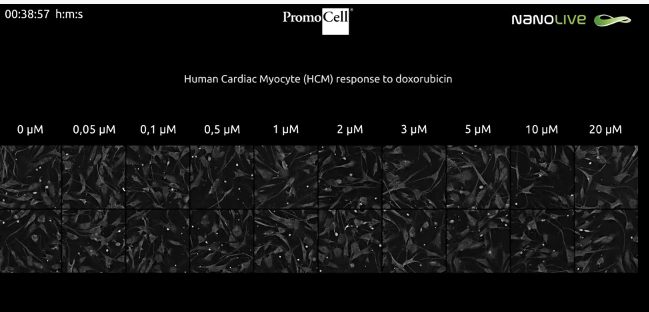
Concentration-dependent cytotoxic effect of doxorubicin on human cardiac myocytes (Promocell) visualized with Nanolive’s label-free imaging.
A standardized workflow for robust results
Capturing EC50 dynamically requires robust and standardized workflows. By combining automated assay technology and standardized analysis workflows with Nanolive, dynamic EC50 becomes a practical, scalable decision‑support metric for more informed, data driven portfolio decisions.
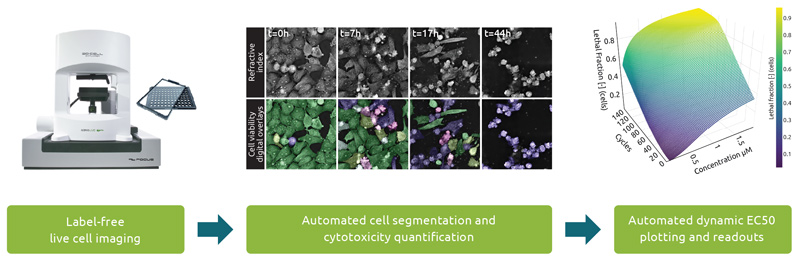
Assessing compound efficacy with dynamic EC50
By integrating intuitive visual evidence, quantitative cell death analysis, and dynamic EC50 measurements, Nanolive’s LIVE Cytotoxicity Assay provides a comprehensive view of compound efficacy and safety, while eliminating the need for labels or endpoint reagents. Capturing the full temporal dynamics of cytotoxicity in a single experiment provides a more accurate and predictive method for evaluating compound efficacy and toxicity, enabling better-informed and earlier decision-making in drug development.
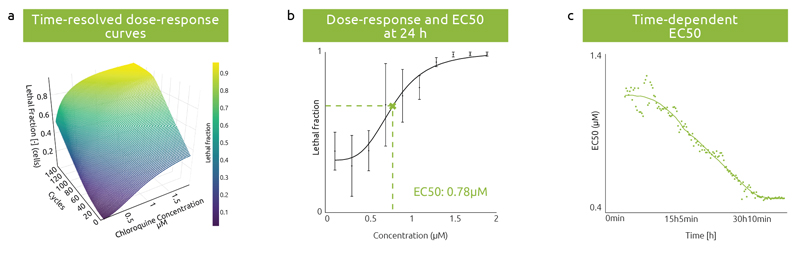
Read the full application note here.
Upcoming event: Nanoparticle delivery webinar

In this upcoming webinar, Elizabeth Nelson shares research performed at the MIT Koch Institute for Integrative Cancer Research, demonstrating a live-cell imaging workflow to quantify the dynamic uptake of nanoparticles, mRNA cargo delivery and transcription, and cytotoxic responses in real time (Nanoscale Horizons, 2026 https://doi.org/10.1039/D5NH00749F).
By reducing the use of fluorescent dyes to visualize cellular structures and to detect cell death, Nanolive’s platform enables long-term live cell imaging with reduced phototoxicity, allowing researchers to dynamically investigate nanoparticle uptake, cargo delivery, and cellular response within a single workflow.
Sign up to attend here.
Latest publications
- Phenotypic profiling: Tsion G. Shiferaw et al. “ApoE Lipidation State Directs Immunometabolic Reprogramming of Human Microglia” bioRxiv (2026). https://doi.org/10.64898/2026.05.04.722733
- Nanoparticle toxicity: Hatice Genc et al. “Gold-modified superparamagnetic iron oxide nanoparticles: Magnetic accumulation under flow conditions and toxicity evaluation in vitro and in vivo” Nanotoxicology (2026). https://doi.org/10.1080/17435390.2026.2652859
- Immunotherapy: Xin Sun et al. “A GSH-responsive stapled oncolytic peptide-STING agonist conjugate for tumor-selective immunotherapy” Science China Chemistry (2026). https://doi.org/10.1007/s11426-026-3506-9
- Cytotoxic drug discovery: Bhaveshkumar B. Makwana et al. “Ferrocene-functionalized dithiocarbamate complexes bearing thiophene arms: synthesis, crystal structure, electrochemical characterization, in silico interaction profiling, and apoptosis induction in HeLa cells” New Journal of Chemistry (2026). https://doi.org/10.1039/D6NJ00551A
- Pathogen defense: Gutiérrez-Expósito. D. et al. ‘Comparative ex vivo responses of ovine and bovine polymorphonuclear neutrophils induced by Neospora caninum tachyzoites’ Veterinary Parasitology (2026). https://doi.org/10.1016/j.vetpar.2026.110797
You can find over 400 publications featuring Nanolive imaging here.
Read our latest news
Online walkthrough – Replace fragmented assays: one workflow for cell therapy assessment

Ferroptosis and CAR-T Engineering: Research from MIT
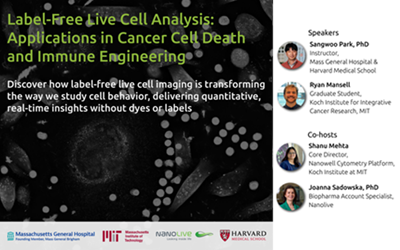
Seminar – Label-Free Live Cell Analysis: Applications in Cancer Cell Death and Immune Engineering
